
Fixing Web3 comms with glitter, strategy, and just enough clarity.
Strategic Intelligence for operators who are done losing to people with worse ideas.
The Rails Open and Issuers Opt Out
"The rails opened. Then everyone with a claim on them showed up."
Vol. 12 asked what remains uniquely crypto if the banks own the rails. Five weeks later, DTCC, NYSE, and Deutsche Bank are opening new paths for tokenized assets—while issuers, regulators, and attackers are making their own claims on what runs through them.
THE RAILS OPEN. ISSUERS OPT OUT.
DTCC switched on a limited tokenization service for 34 eligible securities representing about $30 trillion in market value. That is the value eligible to be tokenized—not value already moved onchain. Twenty firms signed on, while a November filing showed 67 issuers had opted out.
- ▹The securities remain backed one-for-one by assets held at DTC, which keeps the official ownership records. A reported Uber pilot showed tokenized deposits and money-market fund shares settling together over a weekend.
- ▹NYSE selected Avalanche for its planned 24/7 tokenized-securities platform, pending regulatory approval. Deutsche Bank also launched digital-asset custody for European institutions. The rails are opening; issuers and custodians still decide what travels on them.
THE BIGGEST ENTRY POINT WAS A PERSON
Binance reported that attackers drained about $6.34 billion in roughly twenty minutes; about $2.85 billion was reported frozen or intercepted. Binance says it covered the loss. Its preliminary account traces the breach to a malicious coding assignment sent to an engineer, but an independent review is still pending.
- ▹The month’s other incidents involved drained Mercado Bitcoin deposit addresses and an Across phishing site after attackers took over its domain registrar. Those are account, device, and domain-control failures—not just bugs in smart-contract code.
- ▹The custody question is now concrete: when an exchange absorbs a loss, its own balance sheet is the backstop. That is what institutional custody costs, in the same month Deutsche Bank began offering it to clients.
THE GAVELS CHANGE HANDS
Democrats won both chambers, changing the committee leadership expected in January. Crypto PACs spent more than $170 million this cycle, yet Sherrod Brown still defeated Jon Husted in Ohio after more than $60 million was spent against him by crypto-aligned groups.
- ▹Elizabeth Warren is expected to lead Senate Banking. Senator Blumenthal has already requested records from several crypto and political organizations, with responses beginning November 30.
- ▹The Clarity Act’s near-term prospects weakened. CFTC chair Michael Selig says the agency will pursue market-structure rules without Congress if needed, leaving the rulebook—and its political durability—back in play.
THE PREDICTION MARKET GETS CARDED
A federal judge denied Novig’s request to block New York regulators, writing that its sports event contracts are sports betting. New York can pursue enforcement unless Novig obtains a state gambling license or stops offering the product there.
- ▹Courts are split: the Ninth Circuit allowed Nevada to regulate prediction markets as gambling, while a Chicago federal judge sided with Kalshi against Illinois. The legal category is still being contested.
- ▹Prediction markets were marketed as information infrastructure. If sports contracts are treated as gambling, they face a different regulator and a different set of obligations.
PAYMENT COUNTS RISE. DOLLARS BARELY MOVE.
Stablecoin supply grew just 0.4% to $305 billion in the first nine months of 2026, while reported payment activity rose 45% to $482 billion. The shift is toward existing tokens circulating more often, not a comparable expansion in supply.
- ▹Allium counted 68.3 million agent payments in the third quarter, twice the prior quarter, worth $3.7 million in total. That is striking transaction volume with very small aggregate value.
- ▹Payment activity is growing, but it remains a small share of raw stablecoin transfer value. The headline count and the dollars behind it tell different stories.
THE PRICE FALLS AS THE RAILS OPEN
Bitcoin fell to $62,112 on November 15, its weakest level since July 14, and was down about 25% from October 21. Around $2 billion in crypto positions were liquidated over the weekend.
- ▹U.S. spot bitcoin ETFs saw nearly $3 billion in net outflows from October 30 through November 13, according to Farside Investors data reported by Bitbo.
- ▹The institutions tokenizing securities in October were not necessarily buying bitcoin. The rails gained bank partners in the same weeks the asset lost a quarter of its value.
Further Reading
Sources behind the signal
The working answer to Vol. 12: settlement, issuance, and custody are not uniquely crypto anymore. What may remain is open access to rails for people with no seat at DTC. Vol. 14: Blumenthal’s records requests come due November 30, and the Banking gavel changes hands in January.

The Cult of
Sunken Costs
Community Is Retention
"If you need to check a Discord channel to feel okay about your net worth, you are not in a community. You are in a hostage situation."
Crypto loves the word community because it makes financial exposure sound warm.
You are in a hostage situation.
A lot of what crypto calls community is really a cult of sunken costs with better stickers. The members are not just holding tokens. They are holding each other in place.
Once financial exposure becomes identity, selling is no longer a market decision. It becomes a moral failure.
In a healthy community, people can say, “This is not working.” In a sunk-cost community, “the price is down” becomes “the mission is strong,” and “the users are gone” becomes “the real community stayed.” The language changes until judgment sounds like betrayal.
The Tell
"Can people ask reasonable questions, admit doubt, or leave without being punished? If not, it is not community. It is coordinated denial with custom emojis."
A project says “big things coming” and the community writes the novel. It says “ecosystem expansion” and the community explains the strategy. Members provide the defense, patience, content, support, and crisis comms while the project calls it organic growth.
A real community can survive honesty. A cult of sunken costs cannot.

The Messaging
Crime Lineup
Why "Empower" is a Felony
"Step into the morgue. I'm looking at your landing page, and it's cold. There's no pulse. No heat. Just a collection of soft, rounded edges and linguistic beige. You've committed a Messaging Crime, and I'm here to read you your rights."
Felony charge: Promises nothing. Delivers nothing. Linguistic equivalent of a participation trophy.
"I don't want to be empowered. I want to win."
"I don't want to be empowered. I want to solve a problem that is currently setting my hair on fire."
The Verdict
'Empower' is where clarity goes to die. It is used by people who are too afraid to promise a specific result, so they settle for a vague internal feeling.
Strip the adjectives. Burn the fluff. Turn your word cloud into a weapon.
The Architecture of Apathy
The feed isn't broken. Your strategy is. Most founders think they are losing the Algorithm War. They are not. They are losing the Clarity War — and they don't even know a war is being fought.
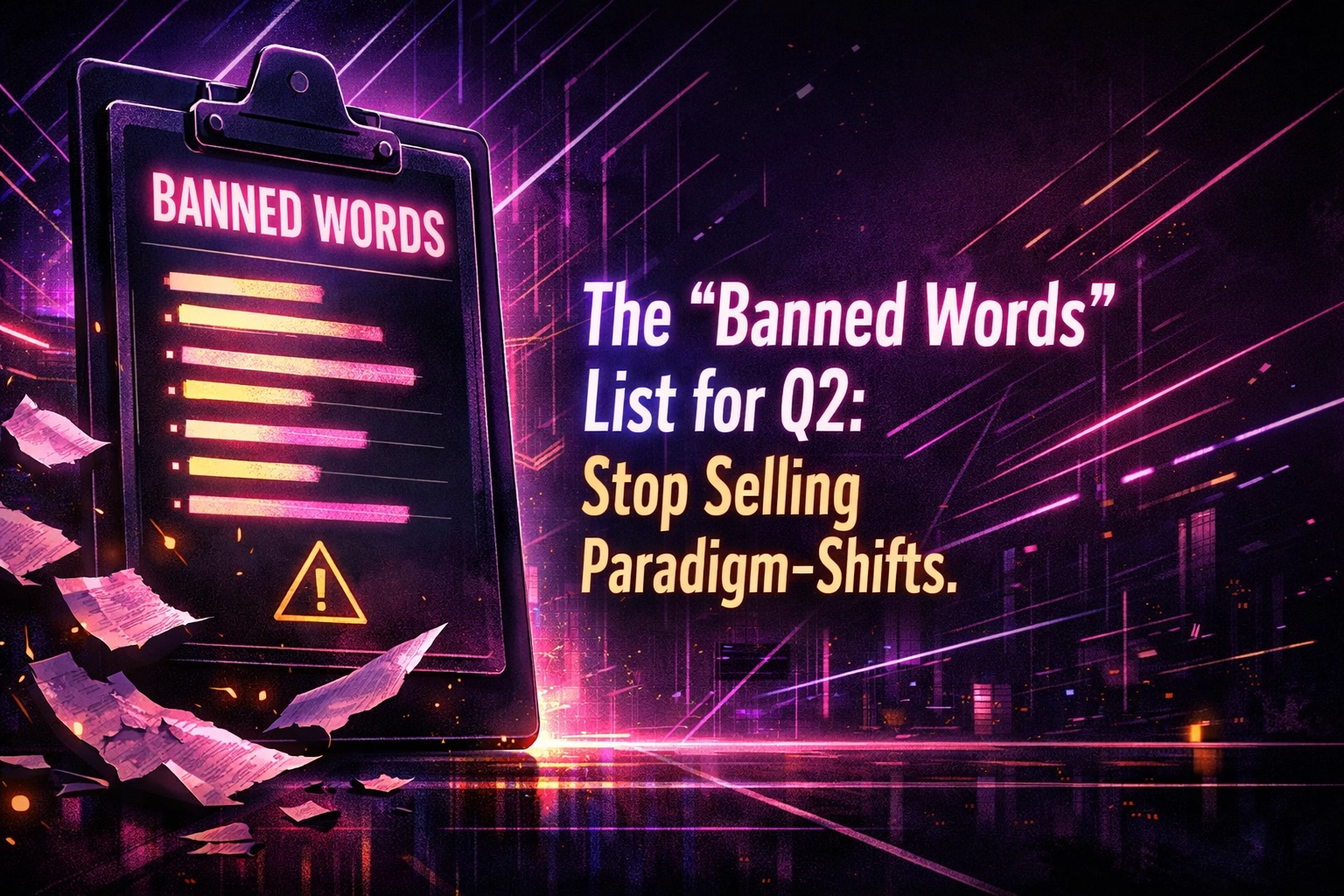
The Banned Words
List
Stop Selling Paradigm-Shifts
The Indictment
The industry is littered with GTM Ghost Ships — fully funded, perfectly staffed projects sailing straight into a void of irrelevance because they refuse to speak like human beings.
They have traded utility for adjectives. Clarity for narrative crimes.
Cause of Death
LINGUISTIC BLOAT
I've performed autopsies on the messaging of the top 50 protocols and fintechs. The cause of death is almost always the same.

Algorithm
Archeology
Stop Blaming the Mirror
"The algorithm is not a god. It is a mirror."
"A cold, indifferent reflection of the energy, clarity, and audacity you bring to the table."
Your strategy is.
I hear it every day. "The algorithm is suppressing me." "Reach is down across the board." "Engagement is a ghost town."
Most founders treat the algorithm like a vengeful, invisible god that must be appeased with burnt offerings of "value-driven" threads and curated lifestyle shots.
They're wrong.
The Diagnosis
You are losing because you're comfortable. You've retreated to the Middle Ground — that dangerous, beige wasteland where most brands go to die.
If you don't like what you see in the mirror, stop screaming at the glass. Start looking at the person standing in front of it.
You Don't Have a Product. You Have a Philosophy.
"Empowering sovereign composability for permissionless participants across decentralized liquidity verticals." There is no explanation of what the product does. You close the tab.
THE DEBT YOU'RE NOT ACCOUNTING FOR
Vocabulary debt is borrowed credibility. It works the same way financial debt works — you get something now and pay for it later, usually at a worse rate than you expected.
- ▹The something you get is the appearance of sophistication. Words like permissionless, composable, and sovereign signal that you've read the right things. They make a landing page feel serious without requiring the product to be serious.
- ▹The payment comes when someone asks a direct question. Founders fluent in abstraction freeze at direct questions because direct questions can be falsified. Abstractions can't. The debt compounds — and the interest rate is your CAC.
THE LINDY LANGUAGE TEST
Take your above-the-fold copy. Your hero statement. The one sentence that's supposed to make someone stay on the page. Now hand it to someone who works at a boring bank.
- ▹Not a crypto-curious fintech person. Someone who processes commercial loans. Someone for whom "decentralized" is not a loaded word — it's just an adjective.
- ▹If they can extract a value proposition in thirty seconds, you have a product. If they hand it back with a polite expression, you have a philosophy. Philosophies don't have CAC. They have believers — and believers are not a business model in a bear market.
THE 3-WORD AUDIT
Take your current above-the-fold copy. Delete every word that ends in -ize, -able, or -less.
- ▹If you're left with a blank screen: you don't have a product. You have a philosophy with a gradient. Before: "Revolutionizing decentralized liquidity provision for permissionless participants." After deleting: "Revolutionizing liquidity provision for participants." Actual fix: "Swap tokens without a middleman taking a cut."
- ▹-ize words are almost always hiding a simpler verb. "Revolutionize" means change. "Incentivize" means pay. "Tokenize" means put on a blockchain. The simpler verb is almost always more honest about what's actually happening. Use it.
WHY SIMPLE IS HARD
The reason founders don't do this isn't laziness. It's that simple language requires you to know exactly what you're doing.
- ▹Abstraction is available at any stage of development. You can write "empowering sovereign composability" on day one, before a single line of code exists. It costs nothing and commits you to nothing.
- ▹Clear language requires answers — who the user is, what problem they have, how your product solves it, why your solution beats alternatives. Most teams haven't figured all of that out yet. Abstract language is the placeholder they forget to replace. Clarity is not a design choice. It's evidence that you know what you're building.
Field dispatches from the intersection of crypto, messaging, and the things nobody says out loud.
We've Seen This Movie. The AI Venture Boom Looks Familiar.
"Capital concentration, paper returns, and the particular exhaustion of watching an industry you love walk toward the basement again."
THE SEQUEL NOBODY ASKED FOR
There's a specific kind of feeling you get when you watch an industry you love make the same mistake twice. It's not quite dread, because you've already done the grief work once. It's more like sitting in a theater for a sequel you didn't ask for, watching the protagonist walk toward the basement again.
- ▹AI startups accounted for 41% of the $128 billion raised by VC-backed companies last year. OpenAI closed a $110 billion round. Anthropic closed a $30 billion Series G at a $380 billion valuation. xAI raised $20 billion in January.
- ▹10% of startups captured 50% of the funding. If you've spent any time in crypto — if you watched 2020 and 2021 turn into 2022 — you know this shape. You know what a market looks like when capital stops making bets and starts making monuments.
THE NUMBERS
The venture market for AI is what analysts are calling 'K-shaped.' At the top: Anthropic, OpenAI, xAI — functionally the infrastructure layer for an entire industry. At the bottom: everyone else.
- ▹Founders building on top of those models. Startups trying to differentiate at the application layer. Companies that can't raise a $30 billion round but still need compute, still need access, still need the infrastructure to keep running.
- ▹This is the part where the pattern starts to feel less like coincidence. The models everyone builds on. The APIs everyone calls. Single points of failure that can be leaned on.
THE CHOKE POINT PARALLEL
Someone on X coined a term: 'DeCognizing.' The idea being that if AI access becomes essential infrastructure — and it's rapidly heading there — then losing that access looks a lot like losing your bank account did.
- ▹Claude users described accounts suspended with no explanation. A fintech CEO's account was disabled for uploading a travel itinerary. A developer who built one of the most popular third-party Claude tools had his personal account suspended — reinstated only after the story went viral.
- ▹The reasonableness of the underlying business logic doesn't protect you when the enforcement mechanism is opaque, automated, and has no appeals process. The crypto community learned this the hard way. It was bureaucratic. It was quiet. It was existential.
WHAT THE IRR DOESN'T TELL YOU
The early returns look good. Funds raised in 2023 and 2024 are posting higher internal rates of return than funds from the 2017-2020 vintage. Here's what that means in practice: no exits. No liquidity. No actual cash returned to LPs.
- ▹Just a higher number in a spreadsheet, waiting for an IPO that's been teased but not scheduled. Crypto had great paper returns too, for a while.
- ▹The technology is real. The applications are real. This is not the 2021 JPEG season. But the structure — the concentration, the opacity, the infrastructure dependency, the paper returns — that structure is one we've seen before. The question worth asking now is whether AI needs to learn that lesson the same way. Or whether we can just remember.
The question worth asking now is whether AI needs to learn that lesson the same way. Or whether we can just remember.
Why Your Whitepaper Sounds Like a Word Search
You open the site. Above the fold: "Empowering sovereign composability for permissionless participants across decentralized liquidity verticals." There's an animated gradient. There's a waitlist button. There is no explanation of what the product does.
You scroll down. There's a roadmap. A team section with LinkedIn icons. A tokenomics diagram with a circle that has twelve arrows pointing at itself. You still don't know what it does. You close the tab.
This is not a communication failure. It's a strategy.
Borrowed credibility paid back at a worse rate. The interest rate is your CAC.
Words like permissionless, composable, and sovereign signal that you've read the right things. They make a landing page feel serious without requiring the product to be serious. The debt compounds when every new hire learns the language as if it's real.
Hand your hero copy to someone at a boring bank. Can they extract a value proposition in 30 seconds?
Not a crypto-curious fintech person. Someone who processes commercial loans. If they hand it back with a polite expression, you have a philosophy — not a product. Philosophies don't have CAC. They have believers. Believers are not a business model in a bear market.
Delete every word ending in -ize, -able, or -less. What remains is your real message.
If you're left with a blank screen: you don't have a product. Before: "Revolutionizing decentralized liquidity provision for permissionless participants." Actual fix: "Swap tokens without a middleman taking a cut." The before version sounds like crypto. The after version sounds like a product. Only one of them closes.
"Clarity is not a design choice. It's not a brand voice preference. It's evidence that you know what you're building and who you're building it for."
Field dispatches from crypto, messaging, and the things nobody says out loud.
The House Always Wins, Except When the House Is Faking It
"Polymarket's marketing department did something crypto has been doing since 2017: sell the appearance of a win instead of the win."
THE PITCH
Here's the pitch prediction markets have been running for two years: this isn't gambling; it's price discovery. The market doesn't lie. The order book is the truth, and everyone can audit it. Polymarket's own marketing team apparently didn't believe that pitch enough to leave it alone.
- ▹A joint Wall Street Journal and Politico investigation dug through a chat archive of close to 20,000 messages between Polymarket's marketing contractor and the creators it paid. The instruction from the top: make every repost feel spontaneous. Personal. Real. It wasn't.
- ▹Of roughly 1,000 videos reviewed from 10 paid creators, around 70% showed the creator placing a bet on camera. Of those, 118 showed the creator 'winning' — nearly $900,000 in fabricated gains. Run the same bets for real, and those accounts would have lost more than $166,000.
THE FAKE WIN MACHINE
One viral clip has a creator wagering on whether Trump will say 'McDonald's' on camera, then cutting straight to him saying it — except the footage was from two months before the bet's resolution window even opened. More than fifty real Polymarket users placed that same bet in January. Every one of them lost.
- ▹Polymarket has been barred from operating its core platform for American users since a 2022 CFTC settlement — yet creators were only paid if 60% of their audience was US-based. A strange thing to prioritize.
- ▹ICE, the parent company of the New York Stock Exchange, has already put $1.6 billion in. Kentucky's AG has separately sued both Polymarket and Kalshi over unlicensed sports wagering. House Oversight has opened its own look into potential insider trading on both platforms.
THE CMO PROBLEM
Polymarket's CMO, Matthew Modabber, ran a chunk of this personally — out of his own PayPal account. North of $350,000 flowing from Modabber directly to creators and commentators across the political spectrum, with the full account sending over $2.5 million to more than 800 people. No FTC disclosure. Nothing marked as an ad.
- ▹Polymarket's official response was a promise to run an audit and a commitment to 'accurate, fair, and transparent markets' — the exact language the entire scandal just spent two months proving the company doesn't practice internally.
- ▹None of the institutional scrutiny — the ICE investment, the Kentucky AG lawsuit, the House Oversight inquiry — started with the marketing story. All of it is now tangled up with it.
THE CJH READ
Prediction markets have spent two years selling themselves as the anti-casino — no vibes, no hype, just aggregated truth. The tell was always going to be what happens when the truth is inconvenient to the growth number.
- ▹Turns out the answer is: pay creators in secret to fake the exact outcome the product claims it doesn't need marketing to produce. You don't get to sell 'the market doesn't lie' and then run a shadow-influencer operation that fakes the market's biggest wins.
- ▹Pick one. Polymarket picked the one that gets you a House Oversight investigation.
You don't get to sell "the market doesn't lie" and then run a shadow-influencer operation that fakes the market's biggest wins. Pick one. Polymarket picked the one that gets you a House Oversight investigation.
CryptoJazzHands is the signal.
JDay Creative is where the signal gets turned into strategy.
I help AI, fintech, Web3, and B2B companies sharpen the story before the market writes a worse one for them.
Messaging. Positioning. GTM narrative. Content systems. Founder voice. The useful knives.
The Signal
Room
Open a Line with the Operator
This isn't a contact form. It's an open frequency.
If you're an operator, a founder, or a strategist who is done losing to people with worse ideas — make contact.
Jenn Day
Strategic Intelligence Operator — CryptoJazzHands